Guide · 10 min read
GEO glossary: 45 terms for AI search, explained
This GEO glossary defines the 45 terms you will meet when you try to get a brand recommended by ChatGPT, Gemini, Perplexity, Claude, Copilot and Google's AI features. Each entry takes one or two sentences, and most link to a guide that goes deeper. Terms are grouped by theme, so you can read one section or the whole list.

How to use this GEO glossary
The terms are grouped into six themes: core concepts, assistants and their features, crawlers and technical access, content, measurement and off-page presence. If you are new to the field, read the first section and the measurement section; they explain most conversations about GEO.
Vendor features change quickly. Product names and behaviours in this GEO glossary reflect each company's own documentation at the time of writing, in November 2026.
Core GEO concepts
The first entries in the GEO glossary describe what generative search is and how it differs from a list of ten blue links.
- GEO (generative engine optimization): The practice of making a brand easy for AI assistants to find, trust and cite when they answer questions. The term comes from a 2023 Princeton-led paper, later accepted at KDD 2024; see what is GEO and our summary of the GEO research paper.
- AEO (answer engine optimization): An older label for shaping content so search features and assistants can lift a direct answer from it, from featured snippets to voice results. How it overlaps with GEO is covered in AEO vs GEO.
- AI SEO: An umbrella term, also written LLM SEO or LLMO, for adapting search optimization to AI-generated results. Most of it rests on classic SEO foundations; see AI SEO and GEO vs SEO.
- Training data and knowledge cutoff: Training data is the text a model learned from, and the cutoff is the date after which it knows nothing unless it searches. What a model remembers about your brand without searching comes from here.
- Retrieval-augmented generation (RAG): A method in which the system first retrieves documents, such as web results, and then writes an answer based on them. It is why a fresh, crawlable page can be cited even if no model was trained on it; see how AI search works.
- Grounding: Tying a generated answer to external sources, such as search results, so it can be checked and linked. Google uses the word for Gemini answers backed by Google Search.
- Query fan-out: Google's name for issuing several related searches across subtopics and sources to build a single AI answer. Google documents it for both AI Overviews and AI Mode; see Google AI Mode.
- Hallucination: A fluent but false statement produced by a model, such as an invented price or a service you do not offer. Clear, consistent facts on your site and on third-party pages leave less room for it.
- Zero-click search: A search that ends without a visit to any website, because the answer appears on the results page or in the chat. It is the background to the debate in is SEO dead.
- Entity: A distinct thing a system can recognize, such as a company, person, product or place, with attributes and relationships. Assistants recommend entities, so being a clearly described one matters.
AI assistants and features
This part of the GEO glossary names the products where recommendations actually appear. Each one has its own sources and quirks.
- AI Overviews: AI-generated summaries at the top of some Google results, with links to supporting pages. Google says a page must be indexed and eligible for a snippet to be shown as a link, with no extra technical requirements; see how to appear in AI Overviews.
- AI Mode: The conversational mode of Google Search for longer questions, comparisons and follow-ups, with links to supporting websites. It shares its rules with AI Overviews; see Google AI Mode.
- ChatGPT search: The part of ChatGPT that searches the web and answers with linked sources. OpenAI says its OAI-SearchBot crawler is what surfaces websites there; see how to get recommended by ChatGPT.
- ChatGPT Shopping: The usual name for the product results ChatGPT shows when someone asks what to buy. OpenAI says these results are chosen independently and are not ads, and merchants can supply a product feed; see ChatGPT Shopping.
- ChatGPT Business Hub: The entry point, opened in beta in November 2026, where a business can claim its profile in ChatGPT, keep its details current and see aggregate insights. OpenAI says claiming does not guarantee better placement; see ChatGPT Business Hub.
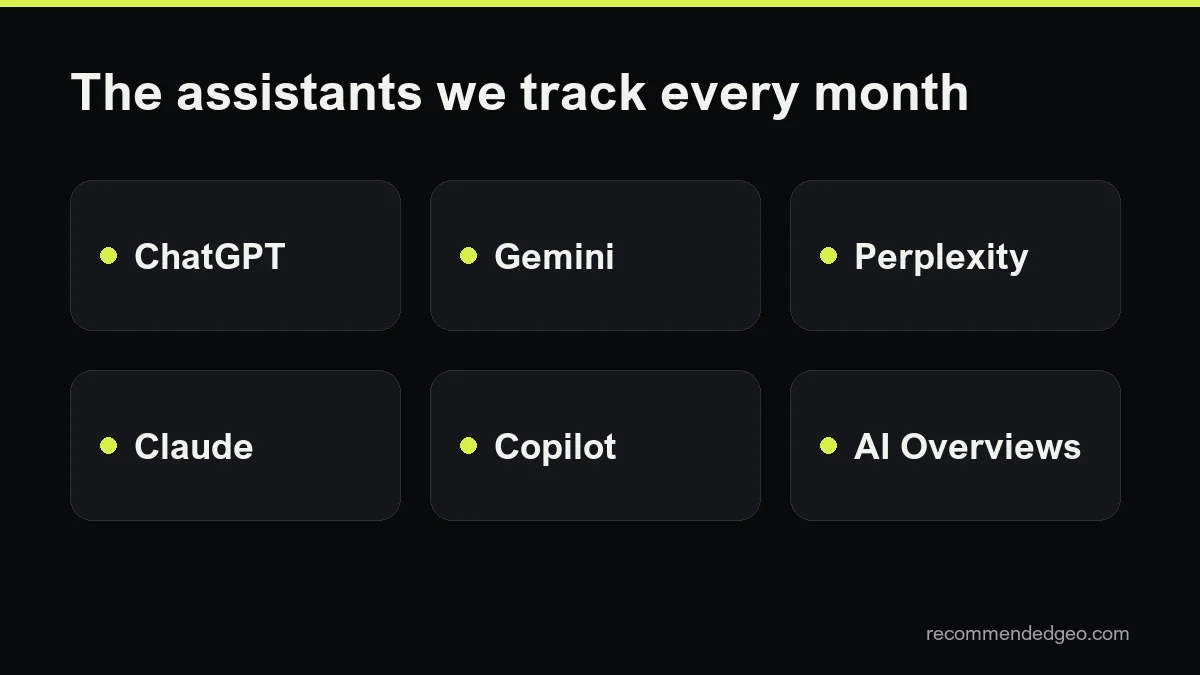
- Gemini: Google's assistant and model family. The Gemini app can ground its answers in Google Search; see how to appear in Gemini.
- Perplexity: An answer engine that searches the web for each question and shows numbered sources. Its index is built by PerplexityBot; see how to rank on Perplexity.
- Claude: Anthropic's assistant, which can search the web and cite pages when web search is turned on. See how to get mentioned by Claude.
- Microsoft Copilot: Microsoft's assistant, whose answers with sources draw on the Bing index. Being crawlable and indexed in Bing is the starting point; see Copilot SEO.
AI crawlers and technical GEO
Nothing else in this GEO glossary matters if assistants cannot read your pages. These are the access terms.
- AI crawler: A bot that fetches web pages for an AI company and identifies itself with a user-agent name. Vendors publish their names, as in OpenAI's crawler list.
- Training crawler vs search crawler: A training crawler, such as GPTBot or ClaudeBot, collects content that may train future models; a search crawler, such as OAI-SearchBot, Claude-SearchBot or PerplexityBot, indexes pages so an assistant can cite them. Blocking the first is an opt-out from training, blocking the second removes you from answers; see robots.txt for AI bots.
- User-triggered fetcher: A bot that visits a page because a person asked the assistant to, such as ChatGPT-User, Claude-User or Perplexity-User. OpenAI and Perplexity say robots.txt may not apply to these visits.
- Google-Extended: A robots.txt control token, not a separate crawler, that governs whether Google may use your content for Gemini training and grounding. Google Search, including AI Overviews and AI Mode, depends on Googlebot instead.
- llms.txt: A proposed Markdown file, published by Jeremy Howard in September 2024, that gives language models a short, curated map of a site. Treat it as optional; we explain where it helps in llms.txt.
- Structured data (schema markup): Machine-readable code, usually JSON-LD with Schema.org vocabulary, that states facts such as organization, product, price or author. It helps systems parse a page, although Google says its AI features need no special markup; see schema markup for AI search.
- JavaScript rendering: Whether a crawler runs scripts to see content built in the browser. Not every AI crawler is documented to render JavaScript, so key content should be in the HTML; see JavaScript and AI crawlers.
- IndexNow: An open protocol that lets a site tell participating search engines, including Microsoft Bing, Naver, Seznam.cz, Yandex and Yep, that a URL was added, updated or deleted. Because Copilot relies on Bing, faster Bing indexing can matter; see IndexNow.
- Technical GEO: The access layer of GEO: crawler permissions, CDN and firewall rules, rendering, speed, structured data and sitemaps. See technical GEO.
Content terms
This section of the GEO glossary covers what makes a page likely to be quoted rather than skipped.
- Citable passage: A short, self-contained section that answers one question with a clear claim, figure or definition, ideally in its first sentence. Retrieval systems pull passages, not whole pages; see how to write content AI cites.
- Prompt research: Finding the questions your buyers actually type into assistants, the counterpart of keyword research. Prompts are usually longer and more conversational than keywords; see prompt research.
- Freshness: How current a page's facts are, shown by visible dates and maintained details. Outdated prices or features on your own pages can be repeated in answers.
- E-E-A-T: Experience, Expertise, Authoritativeness and Trustworthiness, the concepts Google's search quality rater guidelines use to describe reliable content. Named authors, cited sources and first-hand detail support them.
Measurement terms
These GEO glossary entries describe how to tell whether the work is changing what assistants say about you.
- Tracked questions: A fixed set of prompts run in each assistant on a schedule to see which brands appear. Our plans measure 30, 80 or 200 a month; see pricing.
- AI visibility: How often and how prominently a brand appears in AI answers to the questions that matter to it. See how to measure AI visibility.
- Mention vs citation: A mention is your name in the answer text; a citation is a link to one of your pages as a source. You can be cited without being recommended and recommended without being cited, so track both.
- AI share of voice: Your share of mentions or recommendations across a set of tracked questions, compared with competitors. See AI share of voice.
- Sentiment and position: How an answer describes you and where you sit in a list. Fifth place with a caveat is not the same result as first place.
- AI referral traffic: Visits that arrive from links in assistants. OpenAI says ChatGPT adds utm_source=chatgpt.com to referral links, and GA4 now has an AI Assistant default channel, while AI Overviews traffic stays in Organic Search; see ChatGPT traffic in GA4.
- AI Performance report: A Bing Webmaster Tools report, in public preview since early 2026, that shows how often a site's pages are cited in Microsoft Copilot and Bing's AI answers. It is one of the few first-party citation reports available.
- GEO KPIs: The handful of numbers used to judge a GEO programme, such as visibility rate, share of voice, citations and conversions from AI referrals. See GEO KPIs.
Off-page terms
The last part of this GEO glossary covers what other sites say about you, which often weighs as much as your own pages.
- Brand mentions: References to your brand on other websites, linked or not. Assistants retrieve from many third-party sources, so these shape how you are described; see brand mentions for AI.
- Best-of lists: Third-party roundups such as best CRM for startups, which assistants often draw on for recommendation questions. See best-of lists.
- Reddit and forums: Community threads that search engines and assistants surface for experience-based questions. Reddit has announced data agreements with Google and OpenAI; see Reddit for AI search.
- Reviews: Ratings and written reviews on platforms such as Google, Trustpilot or G2, which assistants may summarize when comparing options. See reviews and AI recommendations.
- Wikipedia and Wikidata: The encyclopedia and its structured sister database, both widely used sources of facts about entities. Notability rules are strict, so neither is a marketing channel; see Wikipedia and AI search.
From a GEO glossary to a working plan
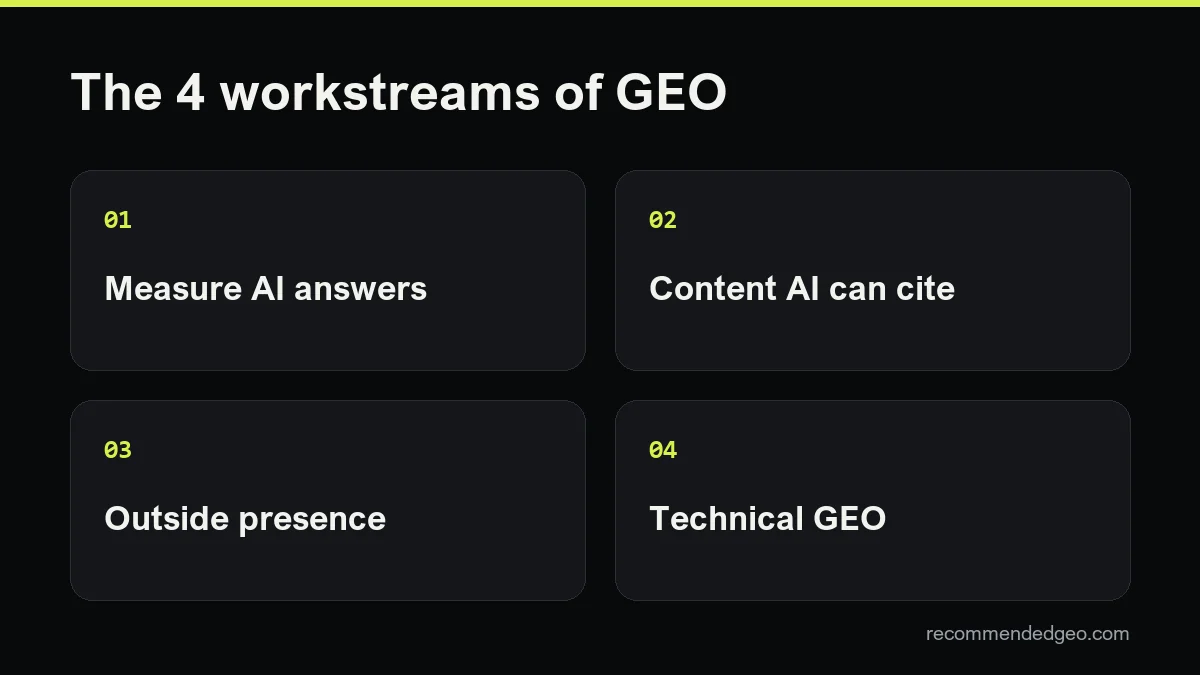
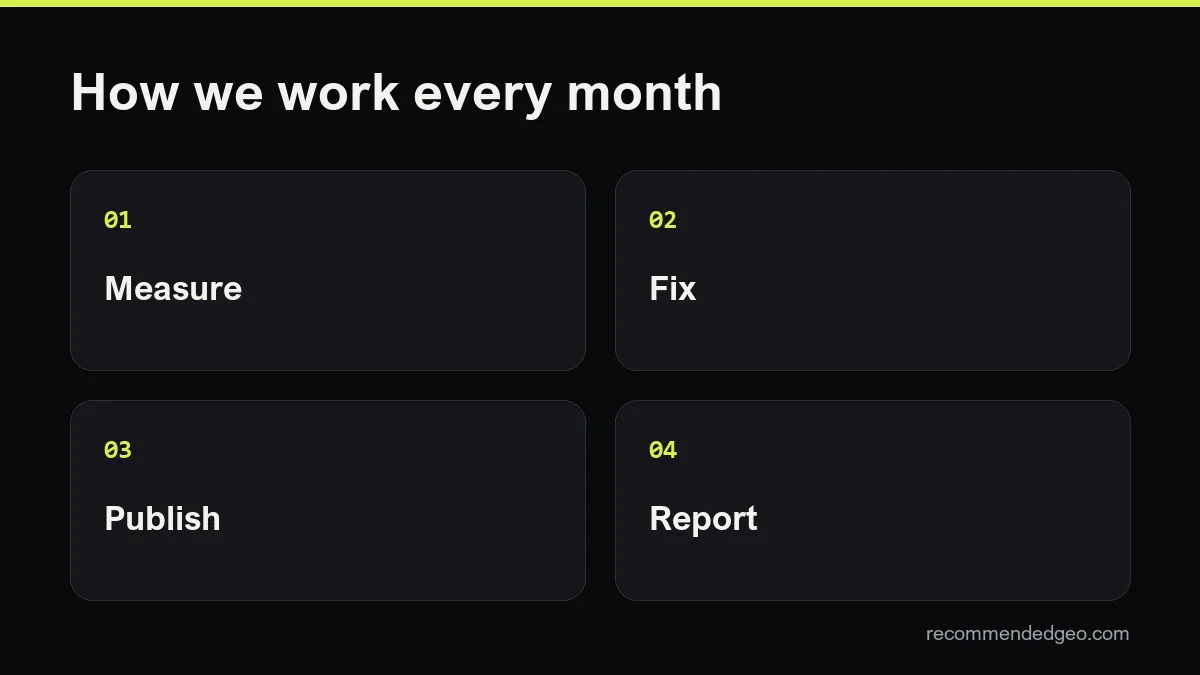
Learning a GEO glossary is the easy part. The work runs in a fairly fixed order: choose the questions to track, fix crawler access, publish citable pages, then build outside presence. GEO strategy explains how to sequence it.
If you would rather see where you stand first, a free GEO audit checks crawler access and runs a sample of questions in the main assistants.
Frequently asked questions
What is the difference between GEO and SEO?
SEO aims for rankings and clicks in a list of results; GEO aims for being mentioned, cited and recommended inside generated answers. They share foundations such as crawlability and useful content, and what is GEO explains where they part ways.
Are AEO, GEO and AI SEO the same thing?
They overlap heavily and many people use them interchangeably. AEO started with featured snippets and voice answers, GEO focuses on generative assistants, and AI SEO is the broadest label. Our AEO agency page shows how we treat AEO inside GEO work.
Which terms in this GEO glossary should I learn first?
Start with tracked questions, search crawler, mention vs citation and AI share of voice. Those four explain what is being measured, what has to be accessible and how progress is reported.
Why does this glossary say at the time of writing?
Because assistant features are renamed and reworked often; Business Hub, for example, only opened in beta in November 2026. Each GEO glossary entry links to a guide; check it or the vendor's own documentation before acting on any feature detail.