Guide · 9 min read
GEO strategy: how to build one in five phases, with a 90-day plan
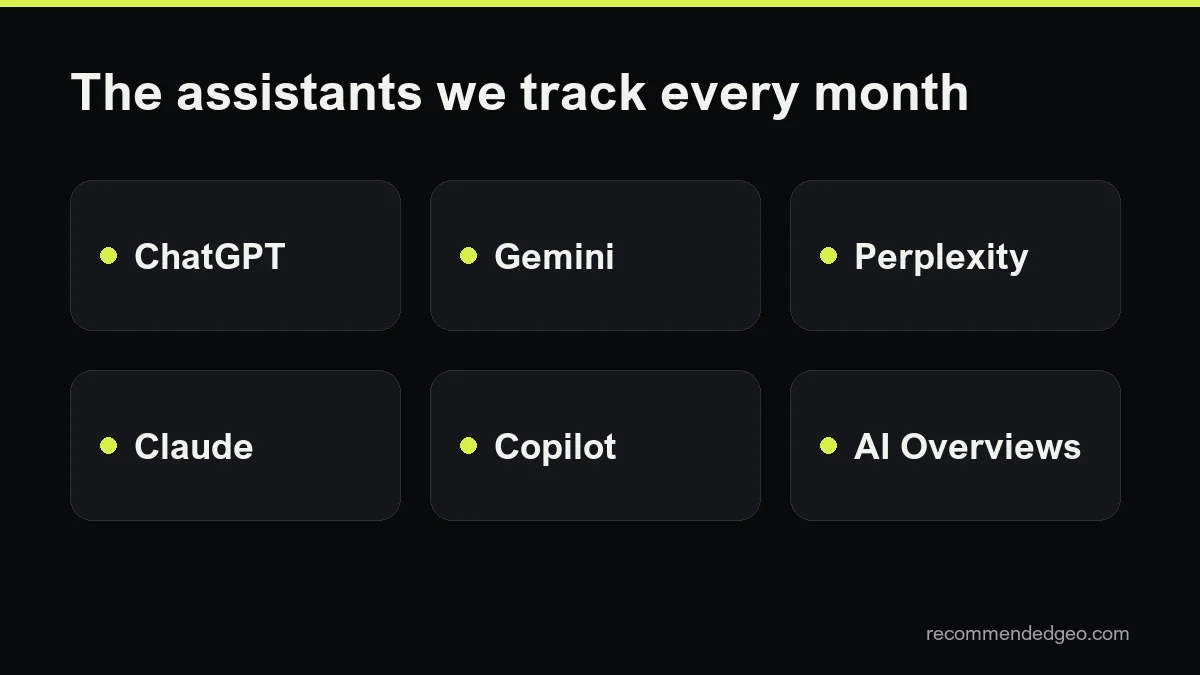
A GEO strategy is the plan that gets your brand named when someone asks ChatGPT, Gemini, Perplexity, Claude, Copilot or Google's AI features for a recommendation. This template splits the work into five phases, turns them into a 90-day plan, shows what to cut when time is short and ends with a checklist you can copy. Each phase links to the guide that explains the how in detail.
What a GEO strategy covers
Generative engine optimization is the work of making AI assistants find, trust and mention your brand. If the term is new, start with what GEO is and how it relates to AI SEO and AEO.
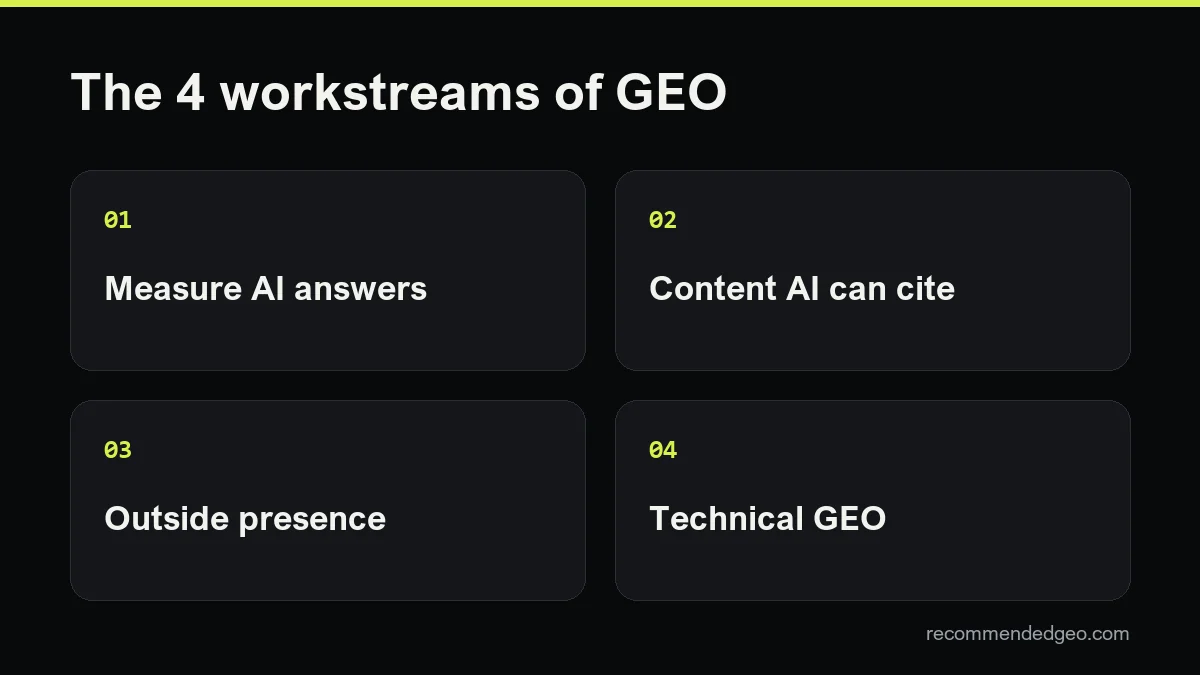
A GEO strategy turns that into an order of work. It answers four questions: which buyer questions matter, whether assistants can read your site, what they find when they do, and what the rest of the web says about you. Measurement wraps around all four.
The five phases below follow that logic. They overlap in practice, but the order matters: content written before the technical checks may sit on pages no assistant can reach.
Phase 1: a baseline built on a question set
Every GEO strategy starts with a list of the questions your buyers ask assistants. Not keywords: full questions, the way a person would type or say them. Our guide to prompt research covers how to collect them from sales calls, support tickets, reviews and search data.
- Aim for 30 questions to start; 80 or more if you sell several products or serve several markets.
- Mix discovery questions (best X for Y), comparison questions (X vs Y), price questions and problem questions.
- Write them in the language and country of the buyer. Answers change by market.
- Freeze the list for at least three months so results stay comparable.
Then run every question in each assistant you care about and record who gets named, in what position, and which sources are cited. That snapshot is your baseline. The method, including how to handle variation between runs, is in how to measure AI visibility.
Fictional example: a small accounting software company writes 30 questions such as best invoicing software for freelancers in Ireland. It finds a competitor named in 19 answers and itself in 3, with two review sites cited again and again. Those two sites go straight onto the off-page list.
Phase 2: technical access
Assistants can only cite what they can fetch and what a search index holds. This phase is short but non-negotiable.
- robots.txt: check that the search crawlers are allowed. OpenAI's crawler documentation states that sites which opt out of OAI-SearchBot will not be shown in ChatGPT search answers, while GPTBot is a separate training setting. Our robots.txt AI bots guide lists the crawlers by vendor.
- CDN and firewall: bot-protection rules can block AI crawlers even when robots.txt allows them. Check the logs, not only the file.
- Google indexing: Google's page on AI features and your website says a page must be indexed and eligible to show a snippet; there are no extra technical requirements. Use Search Console to confirm your key pages are indexed.
- Bing indexing: verify the site in Bing Webmaster Tools, submit a sitemap and consider IndexNow so changes are picked up quickly. Copilot draws on Bing.
- Structured data: Organization, Product, LocalBusiness or Service markup where it fits. Google asks that structured data match the visible text and says no special schema is needed for its AI features, so treat it as clarity, not a trick.
- llms.txt: optional. Read our llms.txt guide before spending time on it.
Phase 3: answer-first content for buyer questions
With access confirmed, map each question in your set to a page that answers it. Where no page exists, that gap goes on the content plan.
- Answer first. Put the direct answer in the first two sentences, then the detail. Our guide to content AI cites explains the structure.
- Comparison pages. If buyers ask X vs Y, publish a fair comparison that names alternatives, including where they are a better fit.
- Pricing pages. Assistants are often asked what something costs. A page with clear prices, or clear price ranges and what drives them, gives them something concrete to quote.
- Use-case and audience pages. Best tool for dentists needs a page about dentists.
- Facts in one place. Founding year, locations, team size, certifications: consistent and easy to find.
For Google specifically, how to appear in AI Overviews and our guide to Google AI Mode cover the details. Most of the same pages serve every assistant.
Phase 4: off-page presence
Assistants lean on what other sites say. The citations you logged in phase 1 tell you which sources matter in your category; that list is the core of the off-page side of your GEO strategy.
- Directories and listings: the ones that appear in your citations first, then the standard ones for your sector.
- Reviews: a steady flow on the platforms assistants cite for your category.
- Comparisons and rankings: getting included in third-party lists. See best-of lists.
- Communities: honest participation where your buyers ask questions. See Reddit for AI search.
- PR and expert commentary: mentions in trade media with consistent facts about the brand.
Our guide to brand mentions for AI explains how to prioritise these and what to avoid, such as paid placements that are not disclosed.
Phase 5: measurement cadence and KPIs
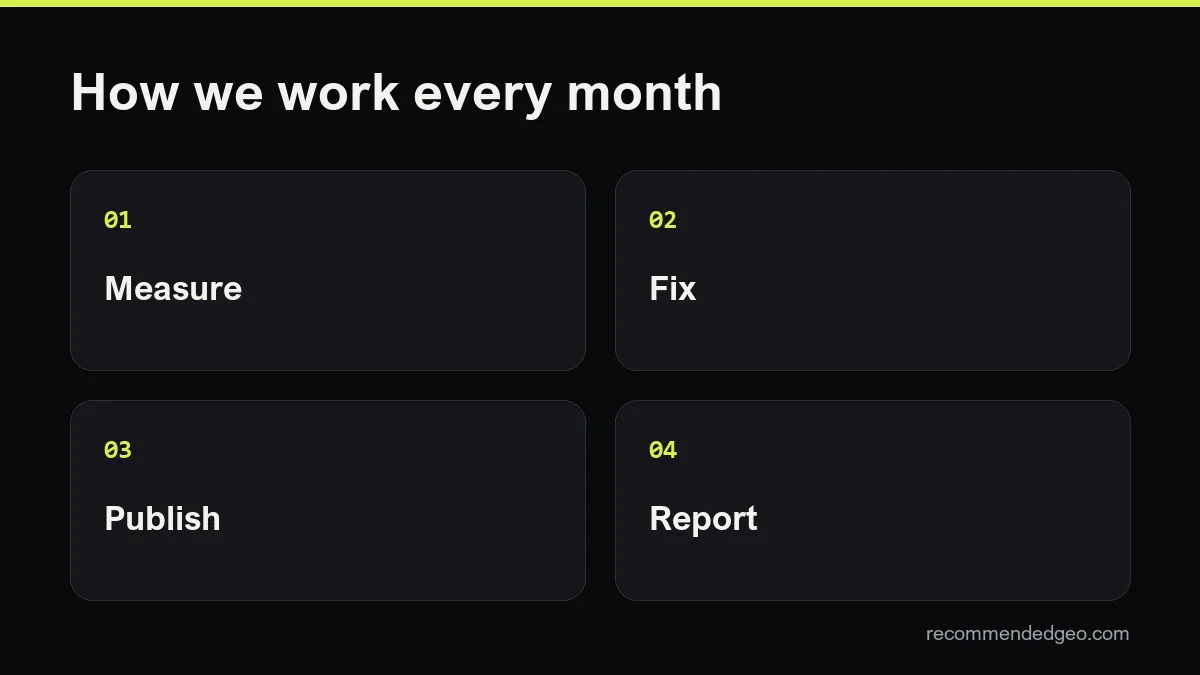
Re-run the full question set on a fixed schedule: monthly for most brands, every two weeks or weekly when you are publishing heavily. Keep the questions, assistants and settings identical so changes mean something.
- Mention rate: share of questions where your brand is named.
- Position: first named, in the list, or only in a footnote.
- Citation share: how often your own pages are cited as sources.
- Share of voice against your three to five main competitors.
- Accuracy: whether what assistants say about you is correct.
- Referral traffic and conversions from assistants. See ChatGPT traffic in GA4.
Two free platform reports help. Google counts AI Overviews and AI Mode traffic inside the Web search type in Search Console. Bing's AI Performance report, in public preview at the time of writing, shows citations in Copilot and Bing's AI summaries but no click data.
A 90-day GEO strategy plan
Ninety days is enough to fix access, publish the first answer pages and see the first movement in mentions. It is rarely enough to change everything, so treat it as the first cycle.
- Weeks 1–2: write and freeze the question set, run the baseline, list competitors and the most cited sources.
- Weeks 3–4: technical access. robots.txt, CDN rules, indexing in Google and Bing, sitemaps, core structured data, fixes to wrong facts on your own site.
- Month 2: content. Rewrite the five to ten pages that map to your highest-value questions in answer-first form; publish missing comparison and pricing pages.
- Month 2, in parallel: off-page. Claim and correct listings, start a review request routine, pitch the two or three comparison sites cited most.
- Month 3: second measurement, compare with the baseline, and write the plan for the next 90 days based on what moved and what did not.
How to prioritise with limited resources
Most teams cannot do every phase at once. If you have a few hours a week, cut in this order and keep the rest for later cycles.
- Never skip the baseline. Without it, you cannot tell whether anything worked.
- Fix blockers next. A blocked crawler or an unindexed page cancels everything else.
- Then fix the pages behind your money questions: pricing, comparisons, the main service or product page.
- Pick one off-page channel, the source cited most in your answers, and work it consistently.
- Measure monthly with the same set; expand only when the first questions improve.
If you would rather hand the work over, our GEO services cover all five phases on a monthly plan, and a GEO audit gives you the baseline and the priority list on its own.
GEO strategy by business type
The phases stay the same; the weight of each one changes with the business model.
- Local business: questions include the city or neighbourhood. Your Google Business Profile, local directories, reviews and consistent name, address and phone carry a lot of weight. Pages per service and per location matter more than a blog.
- B2B and SaaS: questions are comparisons and shortlists. Comparison pages, pricing transparency, integration and use-case pages, review platforms in your category and analyst or trade media lists are the core of a B2B GEO strategy.
- E-commerce: questions name products, budgets and use cases. Product data quality, structured data on product pages, reviews, buying guides and inclusion in third-party best-of lists come first. See ChatGPT Shopping for how product results appear there.
The full GEO strategy checklist
Copy this list into your project tool. Each line is a task with a clear done state.
- Question set of 30+ buyer questions written, by market and language.
- Assistants to track chosen; baseline recorded with mentions, positions and cited sources.
- Three to five competitors and the ten most cited sources listed.
- robots.txt allows the AI search crawlers you want; CDN and firewall rules checked.
- Key pages indexed in Google (Search Console) and Bing (Webmaster Tools); sitemaps submitted.
- Organization and relevant Product, Service or LocalBusiness structured data, matching visible text.
- Each tracked question mapped to a page; gaps listed.
- Answer-first rewrites done for the highest-value pages.
- Comparison and pricing pages published or updated.
- Brand facts consistent across site, profiles and directories.
- Listings claimed; review routine running; top cited comparison sites contacted.
- Measurement re-run on a fixed cadence; KPIs logged; AI referral traffic tracked in analytics.
- Next 90-day plan written from the results.
Frequently asked questions
How long does a GEO strategy take to show results?
Technical fixes can show up within weeks, once crawlers revisit the pages. Changes driven by content and off-page work usually take longer and vary by assistant, so plan in 90-day cycles and judge results against your baseline.
How many questions should the question set have?
Thirty is a practical start for one market. Add more when you sell several products, serve several countries or want to track more competitors. Keep the core list stable so results stay comparable.
Is a GEO strategy different from an SEO strategy?
They share the technical base and much of the content work. A GEO strategy adds question-based measurement in assistants, answer-first formatting and more weight on third-party mentions. See AI SEO for where they overlap.
Do I need llms.txt or special schema?
No. Google says no special files or schema are needed for its AI features. Structured data that matches your page is still useful for clarity, and llms.txt is optional.
Can a small team run a GEO strategy alone?
Yes, if it keeps the scope small: one question set, monthly measurement, blockers first, then the pages and the one off-page channel that matter most. Expand when those move.