Guide · 10 min read
Wikipedia and AI search: what a company can and cannot do
The link between Wikipedia and AI search is closer than most marketing teams assume. Language models learned a large part of what they know about the world from Wikipedia, and knowledge graphs use Wikipedia and Wikidata to tell one entity from another. This guide explains why that matters for your brand, what the rules allow a company to do, and the shortcuts that get accounts blocked.

Why Wikipedia carries so much weight with assistants
Wikipedia matters to assistants for three separate reasons, and it helps to keep them apart.
- Training data. Wikipedia is one of the most widely used text sources for training language models. OpenAI's 2020 GPT-3 paper, for example, listed English Wikipedia among its training datasets. The Wikimedia Foundation itself calls Wikipedia one of the highest-quality datasets for training AI.
- Knowledge graphs. Search engines and assistants keep structured records of entities: people, companies, places, products. Wikipedia articles and Wikidata items are among the public sources these graphs can draw on.
- Entity disambiguation. When two companies share a name, a model needs a way to tell which one a question is about. A Wikidata item with a unique identifier, an official website and a headquarters location is exactly that kind of signal.
In November 2025 the Foundation published In the AI era, Wikipedia has never been more valuable, asking AI developers to credit Wikipedia and to access it through its paid Wikimedia Enterprise service. A month earlier it had reported roughly 8 % fewer human pageviews than in the same months of 2024, which it linked in part to answers shown directly in search.
None of this means a Wikipedia article guarantees a recommendation. It means that what Wikipedia says about your company, or the fact that it says nothing, is part of the material assistants work from.
How Wikipedia and AI search connect in practice
There is no public switch that sends a Wikipedia sentence straight into a ChatGPT or Gemini answer. The connection works through several indirect paths, which is why the effects are slow and hard to attribute.
- A model is trained on a snapshot of the web that includes Wikipedia. What the article said at that time shapes how the model describes you later.
- A search engine builds or updates its knowledge graph using public sources, Wikipedia and Wikidata among them, and uses that graph to decide which entity a query refers to.
- An assistant that searches the web in real time retrieves pages for a question. Wikipedia often ranks for factual queries about organizations, so it is frequently in the set of pages the assistant reads.
- Other publishers copy facts from Wikipedia: founding year, founder names, headquarters. Errors spread the same way.
We explain the retrieval side in more detail in how AI search works. For the vocabulary used here, such as entity, knowledge graph and grounding, see the GEO glossary.
Notability: who gets a Wikipedia article
English Wikipedia's general notability guideline, known as WP:N, presumes a topic deserves an article when it has received significant coverage in reliable sources that are independent of the subject. All three words count: significant, reliable, independent.
For businesses there is a stricter guideline, WP:NCORP. It asks for significant coverage in multiple reliable secondary sources independent of the company, and it lists what does not count:
- Press releases, press kits and articles largely based on them.
- Routine business news such as funding rounds, acquisitions, executive hires, product launches and quarterly results.
- Directory entries, simple listings and best-of lists.
- Interviews and quotes from your own staff, sponsored content and anything you published yourself.
In other words, most of what a PR team produces in a normal year does not establish notability. An in-depth article by an independent journalist, a chapter in a book, or a serious analysis in a trade publication does.
Other language editions apply their own versions. German Wikipedia has its Relevanzkriterien, French Wikipedia has Notoriété with a specific page for companies, Spanish Wikipedia uses Artículos sin relevancia aparente, Italian Wikipedia has Enciclopedicità and Portuguese Wikipedia has Critérios de notoriedade. Their thresholds differ, so a company can qualify in one edition and not in another. For Wikipedia and AI search, that means checking each market separately.
The conflict-of-interest rules
English Wikipedia's conflict of interest guideline covers anyone writing about themselves, their employer, their clients or anything they have a financial relationship with.
- Editors with a COI are strongly discouraged from editing affected articles directly.
- They should disclose the conflict and propose changes on the article's talk page, using the edit COI template so volunteers can review them.
- New articles should go through Articles for Creation instead of being published directly.
- Small uncontroversial fixes are allowed: spelling, broken links, removing vandalism or spam, and correcting very obvious errors.
The other editions say much the same. German Wikipedia asks company accounts to be verified and warns that covert advertising can also be a legal issue under German competition law. Spanish and Portuguese Wikipedia treat their COI pages as official policy, and Italian Wikipedia requires a declaration on the user page and on the talk page of each article.
Paid editing without disclosure is a Terms of Use violation
This is the line companies cross most often. The Wikimedia Foundation's Terms of Use, which apply to every Wikimedia project including Wikidata, require anyone paid for contributions to disclose their employer, client and affiliation. The disclosure goes on the user page, on the talk page, or in the edit summary.
If you hire an agency that edits your article without disclosing it, the violation is theirs and yours. Typical outcomes include blocked accounts, reverted edits, a public note on the article's talk page and, sometimes, deletion of the article.
Be wary of anyone who promises a Wikipedia page for a fee, guarantees that it will stay up, or proposes to write it from accounts that do not mention you. Those promises are usually what undisclosed paid editing looks like, and they are the riskiest bet in Wikipedia and AI search.
Wikidata: the structured side of Wikipedia and AI search
Wikidata is the Wikimedia project for structured data. Each entity is an item with a Q number, a label, a description and statements such as inception date, official website or headquarters location. The data is published under CC0, so anyone, including search engines and AI developers, can reuse it without asking.
Wikidata's notability bar is different from Wikipedia's. An item is acceptable if it has a valid link to a Wikipedia article, if it describes a clearly identifiable entity with serious and publicly available references, or if it fills a structural need. A company without a Wikipedia article can therefore have a legitimate Wikidata item, provided independent references back it.
If you create or improve an item for your own company, the paid-contribution disclosure still applies when you are doing it as part of your job. Keep the item factual and well referenced:
- Official name, aliases and a neutral one-line description.
- Instance of (for example business or enterprise), inception, headquarters location and country.
- Official website and the identifiers for your verified social and registry profiles.
- A reference for each statement, ideally an independent source; your own website is acceptable for basic facts such as the official URL.
Then make your site say the same thing. An Organization block in your schema markup with a sameAs link to the Wikidata item helps connect your website to that entity record.
What a company can legitimately do
One principle runs through Wikipedia and AI search work: volunteers decide what is published, and your job is to supply facts and sources.
- Check what exists. Search Wikipedia in each language you sell in, and Wikidata, for your brand, founders and products. Note errors with the source that contradicts them.
- Fix factual errors through the proper channel. Post a request on the article's talk page, disclose your relationship, quote the wrong sentence and link an independent source with the correct fact.
- Request, do not write. If there is no article and you think the company qualifies, a disclosed draft through Articles for Creation is an option, but volunteers decide whether it is published.
- Maintain a referenced Wikidata item, disclosed, with the facts above.
- Earn independent coverage. This is the step that makes everything else possible: research others want to cite, expert commentary in trade press, original data journalists can use. We cover it in brand mentions for AI.
Google Knowledge Panels and how to claim one
The Knowledge Panel is the box Google shows for an entity in search results. Google says panels are generated automatically from public information on the web and that facts in its Knowledge Graph come from a variety of sources. It does not say Wikipedia is the only one.
If a panel exists for your organization, you can claim the knowledge panel by signing in, searching for your entity and selecting the claim option. Google verifies you through an official profile such as YouTube, Search Console or social accounts. Once verified you can suggest edits with public URLs as evidence, and Google says it can prioritize that feedback.
Google also notes that not every panel can be claimed at the time of writing, and that businesses serving customers at a location should use a Google Business Profile instead. Descriptions taken from third-party sources have to be corrected at the source, which often brings you back to Wikipedia.
How to check your position in Wikipedia and AI search
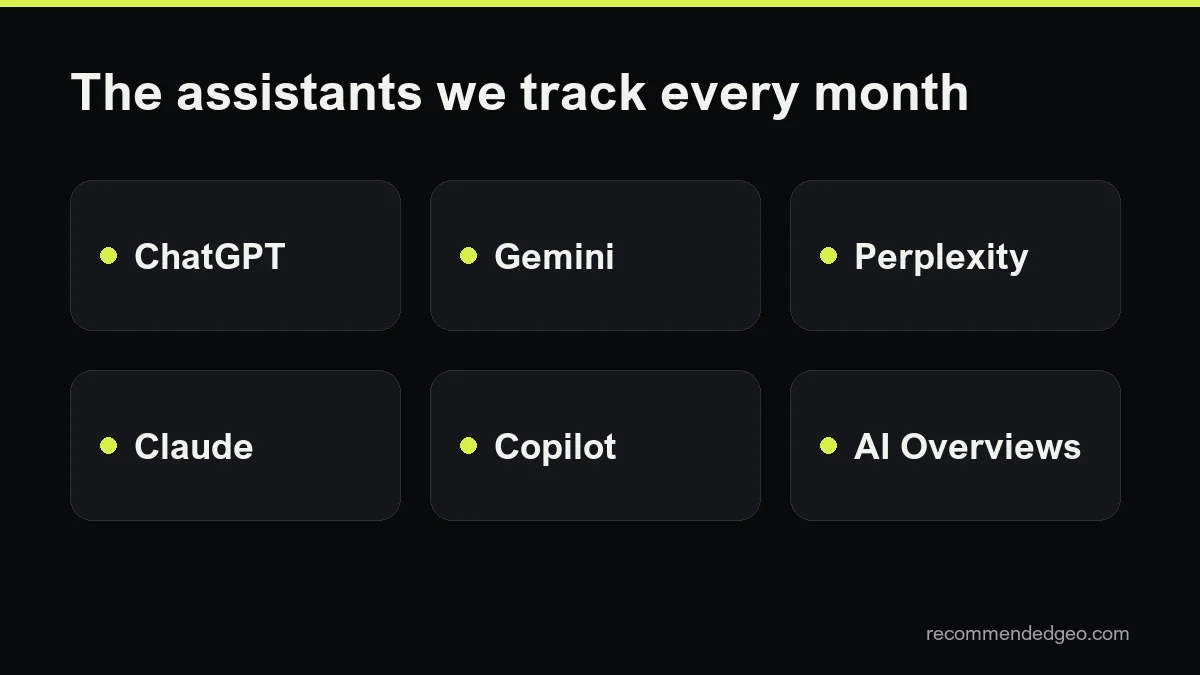
- Ask ChatGPT, Gemini, Claude, Perplexity and Copilot to describe your company. Note which facts are wrong and which sources they cite.
- Compare those answers with your Wikipedia article and Wikidata item. Repeated errors often trace back to one public source.
- Search your brand name alone. If another entity with the same name dominates, disambiguation is your main problem.
- Repeat the same questions every month so you can see whether corrections reach the answers. Our guide on how to measure AI visibility explains how to set that up, and Gemini, which relies on Google's index, is covered in how to appear in Gemini.
Treat the relationship between Wikipedia and AI search as a long-term reputation matter. Accurate, disclosed, well-sourced information helps; shortcuts tend to be found and reversed.
Frequently asked questions
Can my company write its own Wikipedia article?
English Wikipedia strongly discourages it. If you think the company is notable, disclose your conflict of interest and submit a draft through Articles for Creation, or wait until an independent editor writes it. Notability depends on independent coverage, not on who drafts the text.
Is it allowed to pay someone to edit Wikipedia?
Paid editing is not banned outright, but the Wikimedia Terms of Use require the editor to disclose who pays them, on their user page, the talk page or the edit summary. Undisclosed paid editing is a violation and usually ends with blocked accounts and reverted edits.
Does a Wikidata item help even without a Wikipedia article?
It can. Wikidata accepts items for clearly identifiable entities with serious public references, and its data is free to reuse. A referenced item gives search engines and assistants a structured record to match your brand against, although no one can promise it will change a specific answer.
Do I need Wikipedia to get a Google Knowledge Panel?
Google does not say so. It describes panels as generated from public information across the web and lets verified representatives suggest changes. Many organizations with a panel also have Wikipedia or Wikidata entries, but that is a correlation, not a published requirement.
How do I correct a factual error in a Wikipedia article about my company?
Open the article's talk page, disclose your relationship, quote the incorrect sentence and link a reliable independent source with the correct information. Use the edit request template so volunteers see it. Very obvious errors may be fixed directly, but the talk page is the safer route.