Guide · 9 min read
AI share of voice: how to calculate it and report it every month
AI share of voice tells you how much of the conversation you own when people ask assistants about your category. It is a relative number: your mentions compared with everyone else's in the same answers. This guide gives you the formula in plain words, a worked example with a fictional brand, the variants worth tracking, and the mistakes that make the number look more precise than it is.
What AI share of voice means
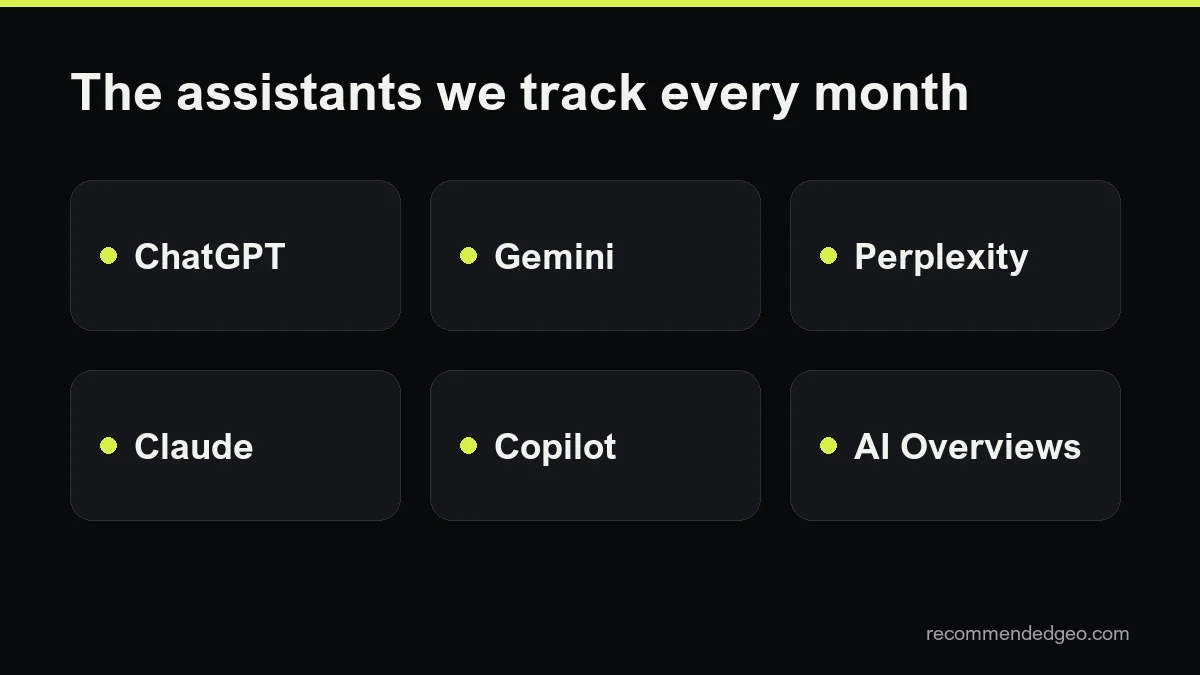
In classic marketing, share of voice is your portion of the advertising or media conversation in a market. Applied to assistants such as ChatGPT, Gemini, Perplexity, Claude, Copilot or Google AI Overviews, it becomes your portion of the brand mentions those assistants produce when answering questions about your category.
The key word is portion. If an assistant names five brands in an answer and you are one of them, you got one fifth of the voice in that answer. Add this up across many questions and you get a share you can compare month to month and against competitors.
This makes it different from a visibility or mention rate, which only asks whether you appeared at all. We cover the absolute measures in how to measure AI visibility. Share of voice adds the competitive layer on top.
What you need before you calculate anything
The number is only as good as the inputs. Before the first calculation, fix four things and write them down:
- A question set: the real questions your buyers ask, worded as they would type them. Building it is a job in itself, explained in our guide to prompt research.
- A competitor set: the brands you will count, usually four to eight. Everything else goes into an 'other' bucket or is ignored, and you must say which.
- The assistants and settings: which products, logged out or logged in, which country, and whether you use the consumer app or an API, because results can differ between them.
- The number of runs: how many times each question is asked per period. Answers vary from one run to the next, so one run per question is rarely enough.
Keep these fixed for as long as you can. If you change the question set or the competitor list, the new numbers are not comparable with the old ones, and the report should say so.
How to calculate AI share of voice: the formula in words
The basic formula is simple. Count how many times your brand is mentioned across all collected answers. Count how many times every brand in your competitor set is mentioned, including yours. Divide the first number by the second and multiply by 100.
A few counting rules keep it consistent:
- Count a brand once per answer, even if the answer names it three times. Otherwise long answers about one brand distort the total.
- Decide whether a passing mention counts the same as a recommendation. Most teams count both and track recommendations separately.
- Treat product names, misspellings and parent brands consistently, with a short alias list.
- Keep answers where no tracked brand appears. They do not change the share, but they tell you how often the category is answered without any of you.
A worked example with a fictional brand
Taskmoor is a fictional project management tool. Its competitor set has three other fictional brands: Planwell, Orbitask and BoardBee. The team tracks 25 questions in four assistants, one run each, so it collects 100 answers this month.
Counting once per answer, the mentions are:
- Taskmoor: mentioned in 30 answers.
- Planwell: 45 answers.
- Orbitask: 25 answers.
- BoardBee: 20 answers.
Total mentions in the set: 30 + 45 + 25 + 20 = 120. Taskmoor's share is 30 / 120 = 25 %. Planwell leads with 37.5 %, Orbitask has 20.8 % and BoardBee 16.7 %.
Note the difference from the visibility rate. Taskmoor appears in 30 of 100 answers, a 30 % mention rate. The share of voice is 25 % because answers often name several competitors at once. Both numbers are correct; they answer different questions.
Variants: mention share, citation share and weighted share
The example above is mention share, the most common version. Two other variants are worth adding once the basic one is stable.
Citation share counts links instead of names. Many assistants show sources next to the answer. Count the citations pointing to your domain and divide by all citations shown in the same answers. In our example, if the 100 answers show 160 source links and 12 point to taskmoor.com, the citation share is 7.5 %. A brand can be mentioned often and rarely cited, or the reverse, which tells you whether the assistant is learning about you from your own pages or from third parties.
Position-weighted share gives more credit to brands named first. There is no standard scale, so pick one and keep it. For example: first place counts 1, second 0.7, third 0.5, fourth or later 0.3.
Suppose Taskmoor was first in 4 answers, second in 10 and third in 16: 4 + 7 + 8 = 19 points. If the four brands together score 86.6 points, its weighted share is 19 / 86.6, about 21.9 %. The drop from 25 % says Taskmoor is often included but rarely the first suggestion.
Sentiment can be handled the same way, but we prefer to report it beside the share rather than inside it. Of Taskmoor's 30 mentions, say 18 were positive, 9 neutral and 3 negative, the negative ones calling it expensive. That split is more useful to a reader than a single blended number.
Share of model and AI visibility scores from tools
You will also see the term share of model. It is generally used for the same idea: how often a model brings up your brand compared with competitors. Definitions vary between the agencies and vendors that use it, so always ask what is counted and over which prompts.
Many tracking tools also show an AI visibility score, often from 0 to 100. These are usually composites that mix presence, position, citations and sometimes sentiment, each weighted in a way the vendor decides. They can be useful for trends inside one tool. They are hard to compare across tools, and a score of 60 means little until you know how it was built.
Before you rely on any score, check:
- Which questions it uses, and whether you can see and edit them.
- How many runs per question and how often they are repeated.
- Which assistants, and whether it queries the consumer product or an API.
- Whether the competitor set is yours or chosen by the tool.
- Whether you can export the raw answers to check the counts yourself.
Bing's Citation Share report
Bing Webmaster Tools is, at the time of writing, the only first-party source we know of that reports a share-style AI metric to site owners. Its AI Performance report, in public preview since February 2026, counts how often your pages are cited in Microsoft Copilot, AI summaries in Bing and some partner integrations. Bing says the data represents a sample of overall citation activity.
In June 2026 Bing announced Citation Share, along with Intents, Topics and Compare, also in preview. Citation Share is the percentage of citations attributed to your site out of all citations shown across all sites for a given grounding query. Bing describes it as an observational metric, not a ranking or competitive scoreboard, and it does not reveal competitor domains.
So it complements your own measurement rather than replacing it. It covers one ecosystem, it works per grounding query rather than per buyer question, and it measures citations, not brand mentions. It is still worth adding to the monthly report, because it is measured by the platform itself.
Pitfalls that make the number misleading
Most bad readings of the metric come from treating a small, noisy sample as a precise measurement.
- Small samples. With 100 answers, a 25 % share could plausibly sit several points higher or lower; as a rough guide, the margin is around plus or minus 8 points. Movements of two or three points from one month to the next are usually noise.
- Variance between runs. The same question asked twice can give different brands. Run each question several times per period, for example three, and use the average.
- Prompt bias. Questions that name your brand, use your product vocabulary or mirror your marketing copy inflate your share. Write questions the way a buyer who has never heard of you would.
- Competitor set bias. Leaving out a strong competitor raises everyone else's share. Review the set every quarter.
- Silent changes. Assistants update models and retrieval without notice. Note the dates of known changes so you do not credit or blame your own work for them.
- Personalization. Memory, location and account history can shape answers. Use clean sessions and a fixed country where the product allows it.
How to report it every month
A monthly report on AI share of voice should be short and repeatable. This is the structure we use:
- One headline figure: your mention share across the whole question set, with last month and the three-month trend beside it.
- The same figure per assistant, because ChatGPT and AI Overviews can tell very different stories.
- The same figure per topic cluster, such as pricing questions, comparison questions and how-to questions.
- Citation share from your own data, and Bing's Citation Share when it is available for your site.
- Position and sentiment notes, with two or three quoted answers that explain the change.
- A short list of what you did this month and what you will change next month.
Show ranges or at least a note on sample size, and resist reporting decimals you cannot defend. Share of voice sits alongside other measures such as referral traffic and conversions; we explain how they fit together in GEO KPIs.
If you want this done for you, every RecommendedGEO plan includes a fixed question set measured each month with the real answers attached. A free GEO audit is a good way to see your starting point.
Frequently asked questions
What is a good AI share of voice?
There is no universal benchmark. It depends on how many competitors your category has and how the question set is built. Compare yourself with your own past months and with the leader in your competitor set, not with a number from another industry.
Is AI share of voice the same as share of model?
They are used for very similar ideas: your portion of brand mentions in model answers compared with competitors. Definitions differ between vendors, so check what each one counts before comparing figures.
How many questions do I need?
Enough to cover the main topics your buyers ask about, run several times each. Thirty questions with three runs gives 90 answers per assistant, which is a reasonable start. Fewer than that and month-to-month changes are hard to separate from noise.
Should I count citations or mentions?
Both, separately. Mentions show whether assistants recommend you. Citations show whether they use your pages as a source. A gap between the two tells you where to work.
Does Google report AI share of voice in Search Console?
Not at the time of writing. Google's documentation says appearances in AI Overviews and AI Mode are counted within overall Search traffic in the Performance report, with no separate share or citation metric. Bing Webmaster Tools currently offers the closest first-party data.