Guide · 9 min read
How to get into the best-of lists AI assistants cite
Ask an assistant for the best accounting software, the best dentist in Leeds or the best GEO agency, and the answer often leans on best-of lists and comparison articles. This guide explains how to find the best-of lists that matter in your category, how to judge them, how to ask editors for a place without bending the truth, what the disclosure rules say about paid placements, and how to publish your own comparisons fairly.

Why best-of lists matter for AI recommendations
Assistants that search the web before answering a recommendation question look for pages that already compare options. A list titled "best project management tools for small teams" answers the user's question almost directly, so it is an easy source to summarize and cite.
You can see this yourself. ChatGPT search, Perplexity, Copilot and Google's AI Overviews show the pages they used, and for "best X" questions those sources frequently include list articles, comparison pages and review roundups. We have no universal figure for how often this happens, and it varies by category and country, so check your own questions rather than relying on anyone's average.
The consequence is simple. If the best-of lists an assistant reads do not mention you, the assistant has less reason to mention you either. Being on those lists is one of the most direct forms of the off-site work described in our guide to brand mentions for AI.
Find the best-of lists cited in your category
Start with the questions your buyers actually ask. Our guide to prompt research covers how to build that list; for this task you only need the recommendation questions.
- Write 10 to 20 questions of the form "best X for Y", "best X in [city or country]" and "X alternatives". Use your buyers' wording, not your internal jargon.
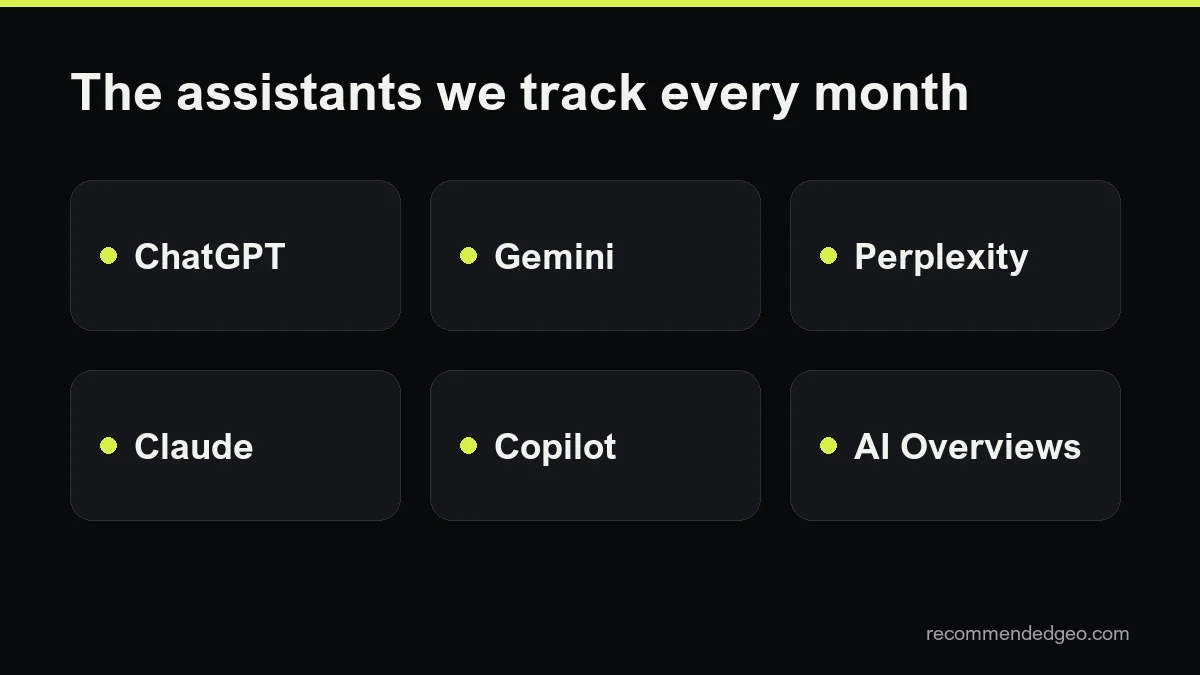
- Ask each question in ChatGPT, Perplexity, Gemini, Copilot and Claude with web search on, and run them in Google to see if an AI Overview appears.
- Open the sources each answer shows and note every list or comparison article: URL, publisher, date, and whether you are on it.
- Search Google and Bing for the same phrases, such as "best payroll software UK" or "best wedding photographer in Lisbon", and add the list articles in the first two pages of results.
- Count how often each URL or publisher appears across questions and assistants. The ones that recur are your priority.
Expect the results to shift from week to week. That is why we treat this as a recurring check, part of how we measure AI visibility, and not a one-off spreadsheet.
How to evaluate a list before you pitch
Not every list deserves your time. Some are thin pages written only to collect affiliate commissions, and some will never be updated again. Before you contact anyone, check:
- Is it cited? A list that appears in assistant answers or ranks for your category phrases is worth more than one nobody sees.
- Is it maintained? Look for an updated date, recent changes to the entries and working links.
- Does it explain its method? Lists that state criteria, testing or sources are more credible to readers, and tend to be the ones editors keep current.
- Is it a fit? A list of enterprise tools is the wrong place for a freelancer product, even if you could get in.
- How does it make money? Note affiliate links, "sponsored" labels or a pay-to-be-listed model. That affects how you approach it, as explained below.
Score each candidate on these five points and start with the top handful. A short list worked well beats fifty cold emails.
How to pitch editors honestly
Editors of best-of lists get many requests, and most are generic. What gets a reply is information that makes the editor's job easier and that they can check.
- A short, specific note: which article, which category or slot you fit, and one sentence on why a reader of that article would care.
- The facts they need to write an entry: what you do, who it is for, pricing or how pricing works, where you operate, and what makes you different, stated plainly.
- Evidence they can verify: links to public reviews on independent platforms, case studies with named clients who agreed to be named, awards or certifications with a source.
- A way to test you: a demo, a free trial or a sample, with no strings attached.
- Honest limits: who you are not a good fit for. Editors notice when a pitch admits trade-offs, and it makes the rest of your claims more believable.
Do not invent numbers, overstate reviews or ask clients to post reviews in exchange for something without disclosure. Apart from the legal risk, an editor who finds one false claim will not trust the rest. If the answer is no, ask what would make you a fit later, and leave it there.
Paid placements, affiliate links and disclosure rules
Many best-of lists earn money from affiliate commissions or sell sponsored slots. Paying for a placement is not automatically wrong, but it changes what both sides must disclose.
- Google's spam policies treat exchanging money, goods or services for links as link spam unless the link is marked with rel="sponsored" or rel="nofollow". A paid listing that passes ranking value without that attribute puts the publisher at risk, and a site that buys many of them takes on risk too. Source: Google Search spam policies.
- In the United States, the FTC's Endorsement Guides say a material connection, such as payment, free products or affiliate commissions, must be disclosed clearly and close to the recommendation. The FTC's own FAQ addresses affiliate links on websites and treats vague labels as inadequate. Source: FTC Endorsement Guides FAQ.
- In the EU, the Unfair Commercial Practices Directive blacklists paid editorial content that is not identified as paid. Since the 2019 Omnibus amendments it also covers search results that hide paid placement or payment for a higher ranking, and fake or commissioned consumer reviews. National laws apply these rules, so check the country you sell in. Source: European Commission overview.
This is general information, not legal advice. The practical rule: if you paid or gave something of value, the reader should be able to see it on the page. If a publisher offers a paid slot without any label, decline.
Publishing your own best-of lists fairly
Publishing your own comparison pages is legitimate, and assistants can cite them like any other source. The condition is that readers know who wrote the page and why you appear on it.
We do this ourselves, so here is exactly how. Our pages on the best GEO agencies in the US, the UK, Canada and Australia list RecommendedGEO first. Each page says, near the top, that we published it, that we put ourselves first because it is our page, that the other agencies are in alphabetical order and not ranked, and that none of them paid to appear.
- State your criteria, and apply them to yourself as strictly as to others.
- Include real competitors, including strong ones, with an accurate summary of what each offers.
- Link to each company's own site so readers can check, and note when you last checked.
- Do not rank competitors on scores you cannot back with testing.
- Correct errors quickly when a listed company tells you something changed.
A self-published list that hides its author is the kind of page that loses trust with readers and editors. A disclosed one is simply a useful page with an obvious bias that the reader can account for. The same principles apply to any content you want assistants to quote; see how to write content AI cites.
Keep your information current
Assistants can repeat what a list said about you two years ago. If your pricing, product or locations change, outdated entries in best-of lists become a liability.
- Keep a sheet of every list that mentions you, with the facts each one states.
- Review it every quarter, or whenever you change prices, plans, branding or service areas.
- Send editors a short correction with a source, such as your updated pricing page. Do not ask for a better position in the same email.
- Keep your own site, review profiles and directory entries consistent, so editors and assistants find the same facts everywhere.
Mistakes that backfire
- Buying unlabelled placements on low-quality list sites. They rarely appear in assistant answers and carry the risks described above.
- Mass-mailing every listicle you find with the same template.
- Creating fake third-party "review" sites that rank you first. This is the kind of deception consumer law prohibits.
- Chasing position one instead of accuracy. Being listed correctly, for the right use case, matters more than the number next to your name.
How to measure whether it worked
Rerun the same recommendation questions every month across the same assistants. Track whether you are named, how you are described and which sources are cited next to you. When a new list mention appears, note the date, so you can see whether answers change in the following weeks.
Do not expect a straight line. Assistants change sources, and one new mention rarely moves every answer. Over several months, consistent presence in the best-of lists your buyers' questions surface is what tends to show up in the results.
Where RecommendedGEO fits
Finding the lists cited for your category, preparing honest pitches and keeping entries current is part of the outside-presence work in our Growth and Scale plans. It sits inside a broader GEO strategy alongside technical access and content. If you want to see which best-of lists already mention your competitors, start with a free GEO audit.
Frequently asked questions
Do AI assistants really use best-of lists?
Assistants that search the web often cite list and comparison articles for recommendation questions, and you can see this in the sources they show. How often it happens varies by assistant, category and country, so check your own questions.
Should I pay to be included in a list?
Only if the placement is clearly labelled as sponsored and the link is marked rel="sponsored" or rel="nofollow". Unlabelled paid placements create legal and search risks for both sides, and the lists that sell them are rarely the ones assistants rely on.
Is it acceptable to rank my own company first on my own site?
It is acceptable if you say so clearly on the page, explain your criteria and describe competitors accurately. We do this on our best GEO agencies pages and state it near the top of each one.
What should I send an editor?
A short note naming the article, the facts needed to write your entry, independent evidence such as public reviews, and a demo or trial. Leave out superlatives you cannot prove.
How often should I check the best-of lists in my category?
Monthly for the questions you track, and at least every quarter for the facts each list states about you. Check sooner after any change to your pricing or services.