Guide · 9 min read
Brand mentions for AI: how off-page GEO works
When someone asks an assistant which tool, agency or clinic to choose, the answer is shaped largely by what other websites say about the options. This guide covers brand mentions for AI: where they come from, which sources tend to matter, how to earn them without cutting corners and how to tell whether the work is paying off.
Why assistants rely on what others say about you
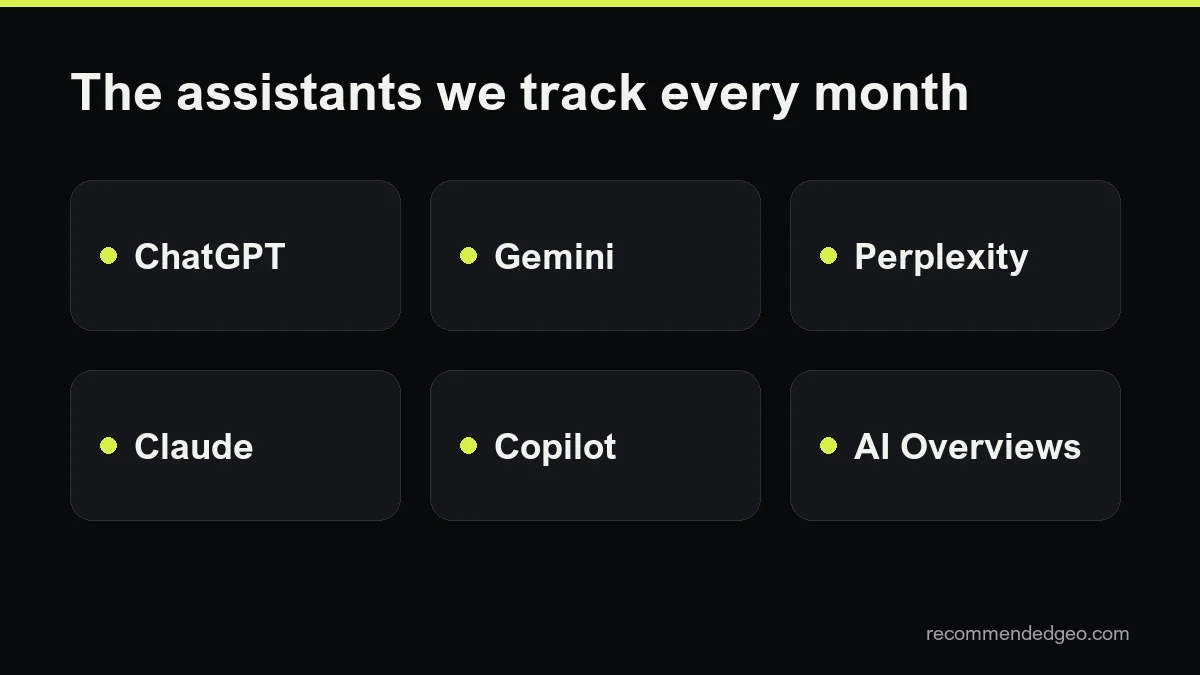
Assistants such as ChatGPT, Gemini, Perplexity, Claude and Copilot answer recommendation questions in two ways. Part of the answer comes from what the model absorbed during training. The other part, increasingly, comes from live web retrieval: the assistant runs searches, reads a handful of pages and writes a summary with citations.
That retrieval step runs on search indexes. Google's AI Overviews and AI Mode draw on Google Search, and Google says they can run multiple related searches across subtopics to pick supporting links. Copilot is built on Bing. ChatGPT search sends queries to third-party search providers, with Bing among them. If your brand is missing from the pages those indexes return for a category question, the assistant has little to work with.
Your own site still matters, because it is where facts about you are confirmed. But when the question is "which is best", a model looks for agreement across independent sources. A brand that only praises itself gives it one source. A brand discussed on comparison pages, directories, forums and in the press gives it many.
Which sources tend to matter
The exact mix depends on your category and country, so treat this as a starting list to check against real answers:
- Comparison and "best X" articles. Pages ranking the top tools, agencies or providers in a category are cited constantly, because they answer the recommendation question directly. Our own ranking of the best GEO agencies in the US is an example of the format.
- Industry directories and review sites. G2, Capterra, Trustpilot, Clutch, Google Business Profile, TripAdvisor or the directory your trade association runs, depending on the sector.
- Wikipedia and Wikidata, if you are notable. They feed many knowledge systems, but they have strict notability rules and are not a marketing channel.
- Reddit and forums. Real discussions where people ask for recommendations and others answer from experience.
- Press and podcasts. Trade publications, local news, interviews and show notes that describe what you do.
- Partner pages. Integration directories, reseller lists, certification registries and customer case studies published by others.
Linked and unlinked brand mentions for AI
In classic SEO, a mention without a link was often treated as a lost opportunity. For assistants, the text around your name carries much of the value. A sentence like "for small clinics, X is the simplest option and costs less than Y" tells a model who you serve and how you compare, with or without a hyperlink.
Links still help. They let crawlers find your site, they pass ranking signals in search engines and they connect a mention to the right entity when two brands share a similar name. So ask for a link when it is natural, but do not reject coverage because it lacks one.
What matters more is accuracy. An unlinked mention that gets your category or location wrong can do more harm than having no mention at all.
Consistent facts across every source
Models reconcile what different sources say. When sources disagree, the model may hedge, pick the wrong version or leave you out. Before chasing new mentions, make the existing ones agree on the basics:
- Brand name, written the same way everywhere, including capitalization and any legal suffix.
- Category: the words you want to be known by, such as "payroll software for restaurants" instead of a vague "business solutions".
- Location and service area, with the same address format on every profile.
- Pricing or price range, where you publish it, plus the date it applies from.
- Founding year, team size, key products and the people who speak for the company.
Write these facts down in one internal document and use it whenever you update a profile, answer a journalist or fill in a directory form. Then make your own site say the same thing in clear, quotable sentences, as covered in our guide to writing content AI cites.
How to find where competitors are mentioned
The fastest research method is to ask the assistants themselves. Write ten to twenty questions a buyer in your category would really ask, such as "best accounting firm for startups in Austin" or "alternatives to X for small teams". Run them in ChatGPT, Gemini, Perplexity, Copilot and Google, and keep the answers.
- Note which brands appear and in what order.
- Open every cited source. Perplexity, Copilot, AI Overviews and ChatGPT search usually show them.
- Group the sources by type: comparison article, directory, forum thread, news piece, partner page.
- Mark which sources mention your competitors but not you. That list is your gap.
- Search Google and Bing for the same questions and check the top results, since many assistant citations come from there.
Repeat the exercise every month with the same questions, because answers change with model updates and new content. Our guide on measuring AI visibility explains how to set up that tracking.
A monthly plan for brand mentions for AI
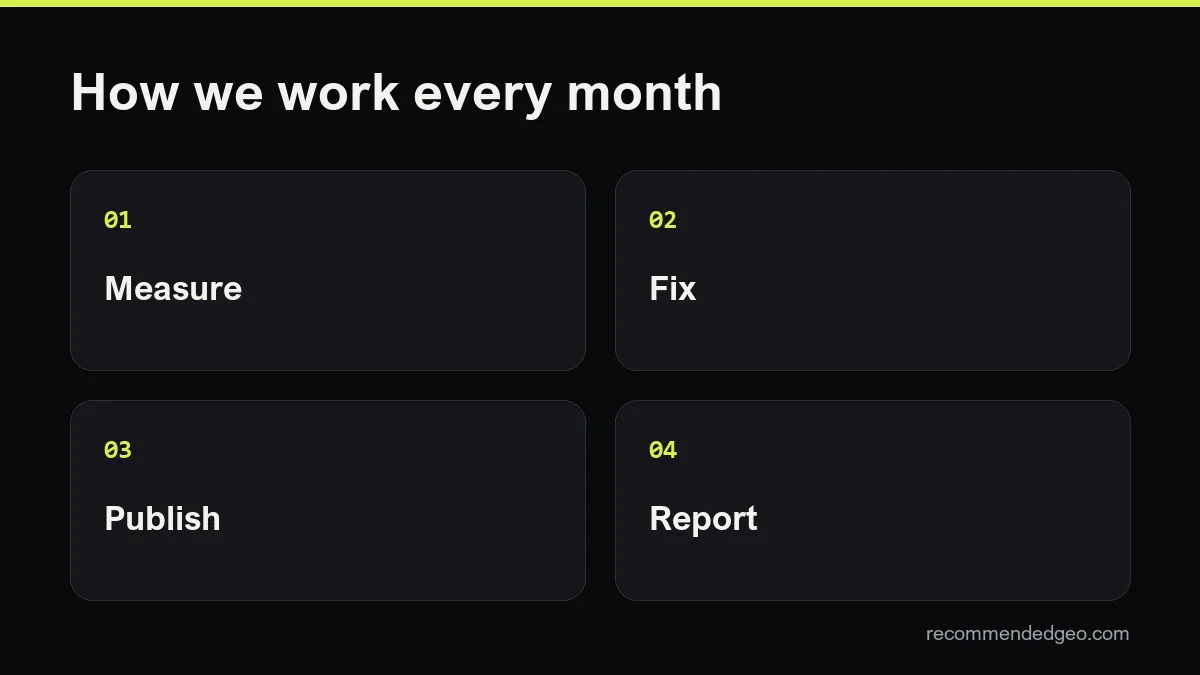
Off-page GEO works best as a steady routine. Here is a five-step cycle that fits most companies:
- Audit sources. Take the gap list from your assistant research and add any directories, review sites and comparison pages that rank for your category questions.
- Fix profiles. Claim and complete the profiles you already have. Correct outdated prices, old addresses, wrong categories and missing descriptions. This is often the quickest win.
- Pitch inclusion in comparisons, honestly. Write to the authors of relevant "best X" articles with facts they can verify: what you do, who it suits, pricing, a customer they can contact. Accept that some will say no, and never pay for placement without disclosure.
- Run digital PR with real data. Publish something worth citing, such as a survey of your customers, anonymized usage numbers or a price index for your sector, and offer it to journalists and newsletters. Original data gets referenced long after the press release is forgotten.
- Ask for reviews. Ask every real customer, at a sensible moment, to leave a review on the platforms that matter in your sector. Do not filter for happy customers only.
Two or three solid actions a month, repeated for half a year, usually do more than a burst of fifty low-quality listings.
What not to do
Some shortcuts look tempting because assistants seem to count mentions. They tend to backfire, and several are against platform rules or the law:
- Fake or incentivized reviews. Google's contributed content policy bans paid reviews, reviews from employees and selectively asking only satisfied customers. In the US, the FTC rule on fake reviews has been in force since October 2024.
- Spam on Reddit and forums. Accounts created to drop your brand into threads get banned by moderators, and the threads that survive are the ones where real users disagree with you in public.
- Paid listicles without disclosure. Buying a spot in a "best X" article is advertising. Google's spam policies say paid links must carry rel="sponsored" or rel="nofollow", and readers deserve to know.
- Editing your own Wikipedia article. Wikipedia's conflict-of-interest guideline strongly discourages it. Propose changes on the talk page instead, with independent sources.
- Mass directory submissions. Hundreds of low-quality directories add noise and can contradict your core facts.
How to measure progress
Mentions are an input. The output you care about is whether assistants include you, describe you correctly and recommend you for the right questions. Track both sides:
- Inputs: number of new or corrected profiles, comparisons that added you, press pieces, new reviews and their average rating.
- Outputs: share of your tracked questions where each assistant mentions you, your position in the answer, whether the description is accurate and which sources are cited.
- Referral traffic: visits from chatgpt.com, perplexity.ai, copilot.microsoft.com and gemini.google.com in your analytics.
Expect slow movement. Retrieval-based answers can change within weeks of a new citation being indexed. Answers based on training data may take until the next model version.
Where RecommendedGEO fits
Our Growth plan includes 2 outside-presence actions per month and Scale includes 5: profile fixes, comparison pitches and directory work on the sources assistants cite for your category. Every plan also covers the on-site side, explained in what GEO is. See the plans and pricing, or start with the free GEO audit to see where your brand stands today.
Frequently asked questions
Do brand mentions for AI need a link to count?
No. Assistants read the text around your name, so an unlinked mention that describes you accurately still helps. Links remain useful for crawling, search rankings and telling similar brand names apart.
Which assistant relies most on third-party sources?
Any assistant that searches the web before answering, such as Perplexity, Copilot, ChatGPT search and Google's AI Overviews, leans heavily on third-party pages. The cited sources they show are the best guide to what matters in your category.
Should we pay to be included in "best X" lists?
Only if the placement is clearly disclosed as advertising and the link is marked as sponsored. Undisclosed paid placements break search engine rules and, in many countries, consumer protection law.
How long until new mentions change AI answers?
For assistants that retrieve pages live, a new mention can show up within weeks once it is indexed. For answers drawn from training data, it can take months. That is why we measure monthly over at least three months.
Can a small business compete with big brands on mentions?
Yes, especially in local or niche questions. A complete Google Business Profile, steady genuine reviews and inclusion in two or three sector directories often matter more there than national press.